

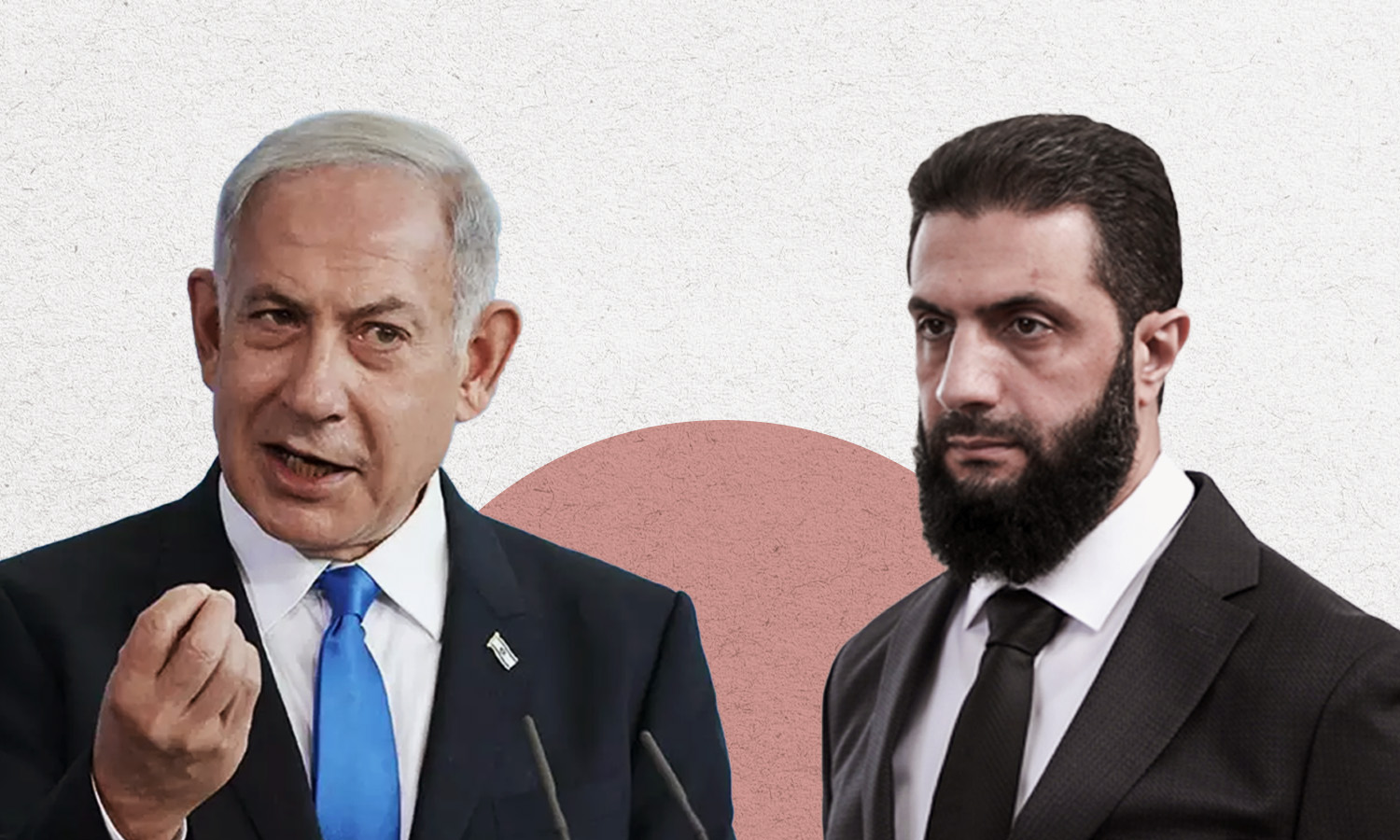
Israel Hayom reported Tuesday that Tzachi Hanegbi, head of the Israeli National Security Council, is conducting a direct dialogue between the Syrian government and Israel, suggesting that Syria could enter the normalization agreements.
According to the Israeli newspaper, Hanegbi told a secret meeting of Knesset members that Syria and Lebanon are candidates for entering the Abraham Accords.
He added that there is a direct dialogue with Syria at all levels, including with the Syrian interim president, Ahmed al-Sharaa, and not an indirect dialogue as previously reported.
During the meeting, which took place on June 22, according to the newspaper, he confirmed that he is personally conducting the dialogue regarding security and political coordination.
Regarding the withdrawal from the buffer zone with Syria, the head of the National Security Council said, “If there is normalization, we will consider the matter.”
Hanegbi neither confirmed nor denied the leaks reported by Israel Hayom, telling the same Israeli newspaper, “I don’t comment on leaks from the committee. It’s shameful that we can’t speak freely, and this will further weaken its position.”
The newspaper quoted MK Merav Michaeli as saying that the operation in Iran should be exploited to conclude peace and normalization agreements with countries in the region, as well as to weaken the Iranian axis politically.
In response, Hanegbi told the Knesset members that Israel and Syria have many things in common, including with Iran.
Leaks
Several leaks have surfaced, discussing possible paths for negotiations and security agreements, some conducted through third-party mediators, and others directly between Syrian and Israeli government figures.
Reuters reported on May 27 that Syrian and Israeli officials had met face-to-face to calm security tensions and prevent conflict on the border in southern Syria.
Reuters quoted five informed sources as saying that the contacts with Israel were led by security official Ahmed al-Dalati, who was then governor of Quneitra and later appointed head of security in Sweida province.
Reuters was unable to determine who on the Israeli side participated, although two sources identified them as security officials.
For his part, al-Dalati denied media reports that he had participated in “direct” negotiation sessions with Israel that evening.
In a statement to the Syrian Al-Ikhbariya channel, he said that these allegations lack accuracy, credibility, and are baseless.
He stressed that Syria’s position regarding negotiations with the Israeli side is “firm and clear,” as he put it, noting that the Syrian government continues to take the necessary measures to protect the Syrian people and defend Syria’s sovereignty and territorial integrity, using legitimate means.
Syrian President al-Shara’a, in response to a journalist’s question during his meeting with his French counterpart, Emmanuel Macron, on May 7, referred to indirect negotiations through mediators to de-escalate tensions between Syria and Israel, without naming the mediator.
Reuters previously reported, citing three sources, that the UAE had established an undisclosed channel of communication between Syria and Israel, coinciding with the new Syrian leadership’s efforts to secure regional support to manage its tense relationship with Tel Aviv.
Negotiations are also underway in the Azerbaijani capital, Baku, in the same context.
With US Support
Indications of Syria’s involvement in Arab countries’ negotiations with Israel regarding joining the so-called Abraham Accords are growing, following public statements by US officials.
The most prominent indication is what US President Donald Trump hinted at in mid-May, following his decision to lift sanctions on Syria and his meeting with al-Shara’a.
Trump said that Syria would eventually join the Abraham Accords, one of the main directives the US president raised with his Syrian counterpart during their meeting, noting that the latter had given initial approval.
Trump linked Syria’s entry into the accords to stability in the country and internal order, according to US media reports, including CNN.
What are the Abraham Accords?
The term “Abraham/Abraham” refers to the consolidation of the values of tolerance, dialogue, and coexistence among different peoples and religions in the Middle East and the world, serving to promote a culture of peace, as stated in the texts of the agreements with Arab countries.
The term was first used during the signing of the normalization agreement between the UAE and Bahrain with Israel under US auspices. It is attributed to the Prophet Abraham, indicating the commonality of the three monotheistic religions: Islam, Christianity, and Judaism.
The Abraham Accords were first signed between Israel, the UAE, and Bahrain at the White House on September 15, 2020, in the presence of former US President Trump, Israeli Prime Minister Benjamin Netanyahu, UAE Foreign Minister Abdullah bin Zayed, and Bahraini Foreign Minister Abdullatif Al Zayani.
On October 23, 2020, Trump announced Sudan’s normalization of relations with Israel, in a joint US-Israeli-Sudanese statement.
On December 10, 2020, Trump announced the signing of a peace agreement between the Maghreb and Israel.
The first peace agreement between an Arab country and Israel was signed by Egypt after the Camp David Accords in 1979, followed by Jordan in 1994.
(Enab Baladi)